

 (416) 656-1170
Root Canal Treatment Near You
If someone has just told you that you need a root canal, take a breath. We know those three words tend to set off alarm bells, and honestly, we get it — the reputation root canals have is way worse than the reality. At Keele Crosstown Dental, we have helped many patients through this procedure, and the most common thing we hear afterward is: “That was so much easier than I expected.”
This page is here to answer every question you are probably typing into Google right now — does it hurt, what happens during the procedure, how long is recovery, and how much will it cost. No fluff, no scare tactics, just clear and honest information.

What Is a Root Canal, Really?
Inside every tooth, beneath the hard enamel and dentine, there is a soft space called the pulp chamber. This pulp contains nerves, blood vessels, and connective tissue that helped your tooth grow during development. Once a tooth is fully formed, the pulp is no longer essential to its survival — it gets everything it needs from surrounding tissues.
When bacteria get deep inside a tooth through a crack, cavity, or repeated dental work, they can reach the pulp and cause infection. Left untreated, that infection does not stay contained — it spreads to the bone and surrounding teeth, causing increasing pain and eventually tooth loss.
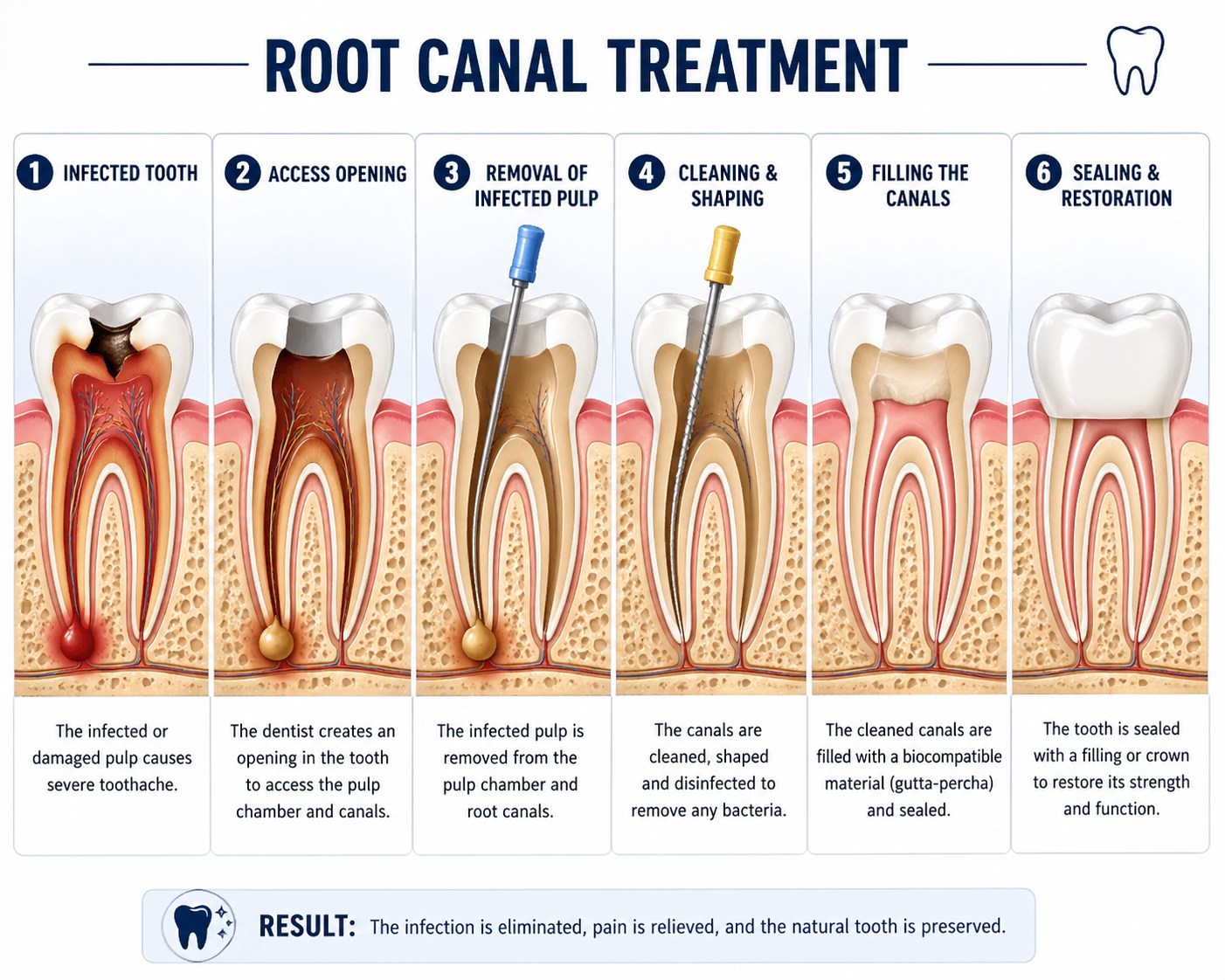
Root canal treatment is the procedure that removes the infected pulp, thoroughly cleans and disinfects the inside of the tooth, and seals it to stop the infection from coming back. The goal is straightforward: save the tooth and end your pain.
Getting here is simple — just follow us on Google Maps for the best route.
Does a Root Canal Hurt? — The Honest Answer
The short answer: No. Modern root canal treatment should not be painful. What hurts is the infection that makes one necessary — not the procedure itself.
This is the biggest fear most patients carry walking in, and it makes complete sense given what root canals used to be like decades ago. But dentistry has changed dramatically. Today, with effective local anaesthesia and refined instruments, a root canal is generally no more uncomfortable than getting a dental filling.
Here is what patients at our dental clinic in York actually experience:
- The anaesthetic injection is the only real moment of discomfort — a quick sting that fades in seconds.
- Once numb, you may feel some pressure or vibration, but not sharp pain. If at any point you feel something uncomfortable, raise your hand and we stop immediately.
- The infection in your tooth is what has been causing the pain for days or weeks. The root canal ends that pain.
- Most patients return to work or normal daily activities the same day or the following morning.
The myth about root canals being unbearable comes from outdated experiences and cultural shorthand that keeps getting passed down. If you are particularly anxious, please tell us before your appointment. We offer nitrous oxide (laughing gas) for nervous patients and will always go at a pace that feels right for you.
Signs You Might Need Root Canal Treatment Near You
Sometimes patients arrive with obvious symptoms. Other times, a routine X-ray reveals a problem before any pain has even started. Either way, catching it early is always better. Here are the warning signs to take seriously:
Throbbing toothache that does not stop — This often points to pulp inflammation or the early stages of infection. Pain that comes and goes is one thing; pain that is constant is a red flag.
Sharp pain when biting or chewing — Pressure on an infected nerve causes this. If eating has become uncomfortable on one side, something is wrong.
Prolonged sensitivity to hot or cold — Sensitivity that lingers for more than 15–20 seconds after the stimulus is removed suggests nerve involvement, not just a sensitive tooth.
A tooth that looks darker or greyish — Discolouration often signals dead or dying pulp tissue inside.
Swollen or tender gum near a specific tooth — This can indicate an abscess forming beneath the surface.
A small pimple or bump on the gum — This is called a fistula, and it is the infection trying to drain. It needs prompt attention.
Pain that wakes you up at night — Night pain with no obvious trigger is a strong sign the infection has progressed and requires urgent care.
One important note: some infected teeth cause no pain at all. A dead nerve cannot send pain signals, even while infection is quietly spreading into the surrounding bone. This is exactly why regular dental check-ups with X-rays matter — problems get caught before they become emergencies.
What to Expect — The Procedure, Step by Step
We want you to walk into your appointment knowing exactly what is going to happen. Most root canal treatments at Keele Crosstown Dental are completed in one or two visits of approximately 60 to 90 minutes each.
Step 1 — Numbing the area Your dentist applies a topical numbing gel to the gum first, then administers the local anaesthetic injection. We always wait until you are completely comfortable before doing anything else. You are in control.
Step 2 — Placing a rubber dam A small rubber sheet is fitted around the tooth to keep the area clean and dry. This also makes the procedure faster and more hygienic.
Step 3 — Accessing the pulp A small opening is made in the top of the tooth to reach the pulp chamber inside. Because the anaesthetic is fully working by this point, this is painless.
Step 4 — Removing the infected pulp Using fine, flexible instruments, the dentist carefully removes the damaged pulp tissue and cleans each canal from the inside.
Step 5 — Shaping and disinfecting The canals are shaped to a consistent size and flushed with a disinfecting solution to eliminate remaining bacteria.
Step 6 — Filling and sealing The cleaned canals are filled with a biocompatible rubber-like material called gutta-percha and sealed to prevent re-infection.
Step 7 — Placing a filling A filling is placed over the access opening. If a second visit is needed, a temporary filling protects the tooth in between appointments.
Step 8 — Crown placement (follow-up appointment) For most back teeth, a dental crown is recommended at a separate visit to restore full strength and protect the tooth long-term.
Recovery After a Root Canal — Day by Day
Recovery is genuinely much smoother than people expect. Here is a realistic picture of what the days ahead look like:
Day 1 — The numbness wears off over two to four hours. Mild to moderate soreness around the treated area is normal. Over-the-counter pain relief handles this well for most patients.
Days 2–3 — Some tenderness when biting on that side is common. Soft foods help. Most patients find ibuprofen or acetaminophen more than enough.
Days 4–7 — Soreness fades noticeably. You can gradually return to normal foods. The temporary filling may feel slightly different to your tongue — that is completely normal.
Week 2 and beyond — The majority of patients feel completely back to normal. A crown appointment is typically scheduled within two to four weeks.
Long-term — A properly restored root-canal-treated tooth can function for a lifetime with regular care and check-ups.
Tips to help recovery go smoothly:
- Avoid chewing hard foods on the treated side until your crown is placed
- Take anti-inflammatories as directed if there is soreness
- Keep brushing and flossing, but be gentle around the treated area
- Call us if swelling increases significantly after day two, or if pain is not improving — these situations are uncommon but we want to hear from you
Root Canal vs. Tooth Extraction — Which Is Actually Better?
This question comes up often, particularly when patients are thinking about upfront cost. Our honest answer is always the same: saving a natural tooth is almost always the better choice — medically and financially.
Root Canal Treatment:
- Preserves your natural tooth permanently
- Maintains your bite and chewing function
- Prevents bone loss in the jaw
- Costs $500–$1,500 for the procedure plus a crown
- Recovery is 2–4 days of mild soreness
Tooth Extraction:
- The tooth is lost permanently
- Surrounding teeth shift toward the gap over time
- Jawbone gradually shrinks without the tooth root stimulating it
- Extraction alone costs $200–$500, but replacing the tooth with an implant costs $3,000–$5,500 CAD or more
- Healing takes one to two weeks
Pulling a tooth might feel like the simpler option in the moment, but it rarely is when you look at the full picture. If Root Canal Treatment near you can save the tooth, it almost always makes more sense to take that route. We will always be honest with you about whether a tooth is worth saving — and when extraction genuinely is the right call, we will tell you that too.
Root Canal Treatment Cost in York — What You Can Realistically Expect to Pay
We believe in being completely upfront about pricing, and we always provide a personalised quote before any treatment begins. The cost of a root canal in York depends on a few key factors — primarily which tooth is being treated and how complex the procedure is. Here is a general overview of what shapes the pricing.
How Tooth Type Affects Cost
Different teeth have different levels of complexity, and this is one of the biggest factors in determining the overall cost of treatment.
Front teeth (incisors and canines) are typically the most straightforward cases, with a single root and easier access making the procedure simpler from a clinical standpoint.
Premolars sit in the middle of the mouth and can have one or two roots depending on the specific tooth, placing them in a moderate range of complexity.
Molars at the back of the mouth are the most involved, often containing three to four canals. That said, these are the teeth you rely on most for chewing, which makes saving them especially worthwhile.
Re-treatment cases — where a previously treated tooth requires a second root canal — are more complex, as the original filling material needs to be carefully removed before work can begin.
What About Crowns?
In many cases, a crown is recommended after a root canal, particularly for back teeth. Root-canal-treated teeth can become more brittle over time, and a crown helps protect against fracture and restores full function. Front teeth may or may not need one depending on the amount of remaining tooth structure. We will always advise you based on your specific situation rather than a one-size-fits-all approach.
Get a Clear Quote Before You Commit
Every patient receives a personalised cost estimate before treatment begins. If you have dental insurance, our team will help verify your coverage and handle the claims process. And if cost is a concern, ask us about flexible payment options — we want to make sure the care you need is always within reach.
Does Insurance Cover Root Canal Treatment?
Most dental insurance plans in Ontario provide partial coverage for root canal treatment, particularly when it is medically necessary. Coverage typically falls between 50% and 80% of the procedure cost, subject to your annual maximum.
The Canada Dental Care Plan (CDCP), launched in 2024, may also cover a portion of root canal costs for eligible Canadians — those without private dental insurance and with household incomes under $90,000. Coverage amounts vary by income tier.
We help patients navigate their insurance and submit claims correctly. If you are unsure about your coverage, call us before your appointment and we will do our best to help you understand what to expect out of pocket.
Payment plans are available. We do not want cost to be the reason someone sits in pain. Ask our front desk team about flexible payment options at your consultation.
Why Patients Choose Keele Crosstown Dental for Root Canal Treatment in York
A root-canal-treated tooth can genuinely last a lifetime — but it does need your ongoing attention:
- Get the crown placed promptly. An uncrowned root-canal tooth is vulnerable to cracking. Do not delay this step.
- Brush twice daily and floss once a day. The treated tooth cannot decay from the inside anymore, but the gum and bone around it still need care.
- Come in for regular check-ups. We monitor treated teeth at every recall visit to catch any rare issues early.
- Avoid using teeth as tools — biting nails, chewing ice, or opening packaging puts unnecessary stress on any tooth.
Ready to End the Pain? Book Your Consultation at Keele Crosstown Dental
If you are sitting with a toothache right now, or your dentist has referred you for Root Canal Treatment in York, please do not delay. The longer an infection is left, the more complex — and costly — the situation becomes.
At Keele Crosstown Dental, we treat anxious patients every single day. We explain everything, go at your pace, and make sure you leave feeling better — physically and mentally. We are here for patients across York, Toronto, and surrounding communities who are looking for Root Canal Treatment near you from a team they can actually trust.
Call us to book your appointment, or use our online booking to find a time that works for you. Same-day appointments are available for dental emergencies.
FAQs
Conveniently Located Dental Clinic Serving York & Surrounding Areas
Our dental clinic is conveniently located on Eglinton Avenue West in York, Toronto, offering easy access via public transit and free parking for all our patients. This central location makes it easy for those seeking a dental clinic nearby to receive high-quality care without the hassle of long travel.
We proudly serve patients from York and surrounding neighbourhoods, providing accessible, dependable, and personalized dental care close to home.
