

 (416) 656-1170
Dental Bridges Near You
If you’ve lost a tooth — or even a few — you already know how much it changes things. Chewing becomes uncomfortable, your smile feels incomplete, and over time, surrounding teeth can start shifting into the gap. One of the most reliable and time-tested ways to fix this is with a dental bridge.
At Keele Crosstown Dental, we help patients in the area understand their options clearly before committing to any treatment. Whether you’ve already been told you need a bridge or you’re just starting to explore, this guide will walk you through what dental bridges are, how they work, how they compare to implants, and what different types of bridges mean for your specific situation.
What Exactly Is a Dental Bridge?
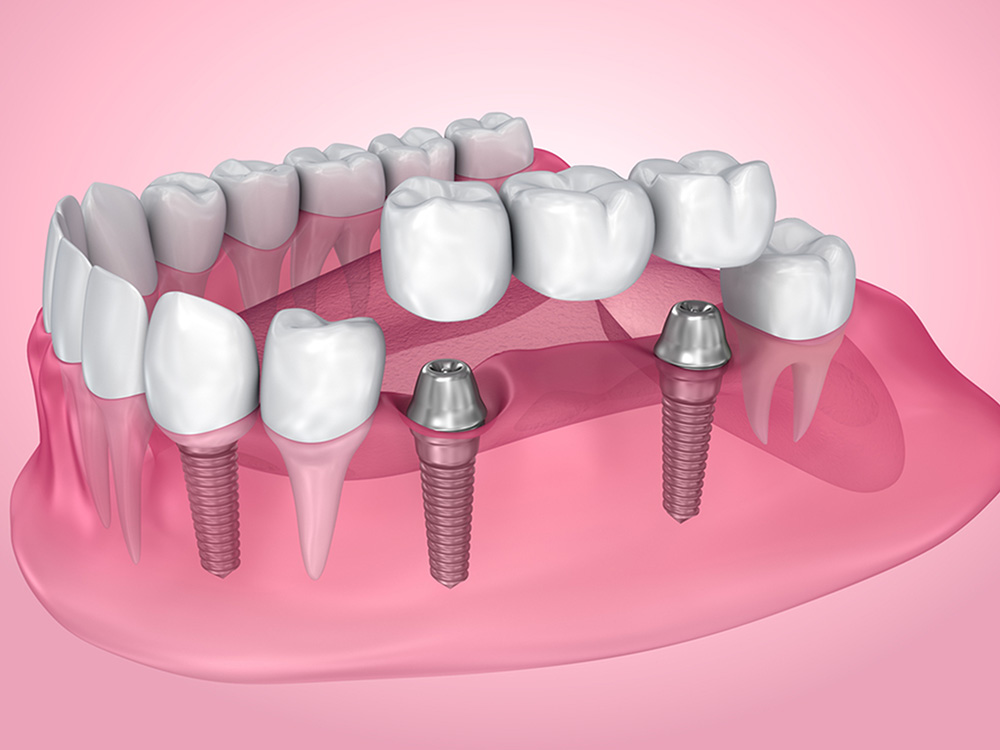
A dental bridge is a fixed dental restoration used to replace one or more missing teeth. The name makes a lot of sense once you understand how it works — it literally bridges the gap left behind by a missing tooth. At the centre of the bridge sits a false tooth, called a pontic, which fills the empty space. On either side of that pontic are crowns that are placed over your existing natural teeth, which are called abutment teeth. These abutment teeth act as anchors, holding the entire bridge securely in position.
What makes a bridge different from something like a denture is that it’s cemented in permanently. There’s nothing to take out at night, no soaking in a glass by your sink, no clicking or shifting when you speak. Once your bridge is placed, it stays put — and you go about your daily life eating, laughing, talking, and brushing just as you would with your natural teeth. Most people adapt to their bridge very quickly and forget it’s even there.
It’s also worth knowing that dental bridges near you have been around for a long time. This isn’t a new or experimental treatment — it’s one of the oldest and most thoroughly studied solutions in all of restorative dentistry. Dentists have been placing bridges for generations, which means the techniques, materials, and outcomes are extremely well understood. That long track record gives patients — and dentists — a lot of confidence in the results.
Why Replacing a Missing Tooth Actually Matters?
A lot of people think, “It’s just one tooth — it’s not that big a deal.” But the reality is, a missing tooth sets off a chain reaction in your mouth that can quietly cause bigger problems down the road.
When a tooth is gone, the bone underneath it starts to shrink because there’s nothing stimulating it anymore. The teeth on either side of the gap can start to drift or tilt toward the empty space. The tooth directly above or below the gap can start to “over-erupt” — growing in more than it should because there’s nothing pushing back against it.
All of this shifts your bite, changes how your jaw moves, and can eventually lead to jaw pain, headaches, worn-down teeth, and even more tooth loss.
Replacing a missing tooth isn’t just cosmetic. It’s genuinely important for the long-term health of your mouth.
3-Unit Bridge vs. 4-Unit Bridge: What’s the Difference?
This is one of the most common questions we get, and it’s an important one. The number of “units” in a bridge refers to how many crowns are involved — including both the false tooth (or teeth) and the crowns placed over the anchor teeth.
3-Unit Bridge
A 3-unit bridge is the most common type. It replaces one missing tooth using three crowns total:
- Crown 1 — placed over the abutment tooth on the left
- Crown 2 (Pontic) — the false tooth that fills the gap
- Crown 3 — placed over the abutment tooth on the right
This is a straightforward solution and works well when a single tooth is missing and the neighboring teeth are in good condition. The two anchor crowns are custom-made to fit over your existing teeth, and the pontic sits in between, filling the space and restoring your bite.
Typical use case: One missing molar, premolar, or front tooth with healthy adjacent teeth.
4-Unit Bridge
A 4-unit bridge replaces two adjacent missing teeth using four crowns total:
- Crown 1 — anchor on one side
- Crown 2 (Pontic) — first false tooth
- Crown 3 (Pontic) — second false tooth
- Crown 4 — anchor on the other side
This configuration puts more stress on the anchor teeth since two pontics are being supported. The dentist must carefully assess the health and strength of the abutment teeth before recommending this approach.
Typical use case: Two consecutive missing teeth, often in the back of the mouth.
Beyond 4 units: It is possible to have even longer bridges — 5 or 6 units — but these require very careful planning. The longer the span, the more the anchor teeth must bear the load. In these cases, implants may actually be a smarter long-term investment.
Quick Comparison Table
| Feature | 3-Unit Bridge | 4-Unit Bridge |
|---|---|---|
| Teeth replaced | 1 | 2 |
| Total crowns | 3 | 4 |
| Complexity | Moderate | Higher |
| Pressure on anchors | Standard | Increased |
| Cost | Lower | Higher |
| Ideal for | Single tooth loss | Two consecutive missing teeth |
Types of Dental Bridges
Not all bridges are made the same way. Depending on your specific situation, your dentist at Keele Crosstown Dental may recommend one of the following:
Traditional Bridge
This is the most common type. It requires the adjacent teeth to be filed down and fitted with crowns to anchor the bridge. It’s strong and durable, making it suitable for back teeth where chewing force is highest.
Cantilever Bridge
A cantilever bridge is used when there’s only one natural tooth next to the gap. Instead of anchors on both sides, it connects to just one abutment tooth. It’s less common today because it can put excessive stress on that single anchor tooth, especially in the back of the mouth.
Maryland Bridge (Resin-Bonded Bridge)
A Maryland bridge doesn’t require crowns at all. Instead, it uses metal or porcelain wings that are bonded directly to the backs of adjacent teeth. It’s more conservative because no enamel is removed — but it’s generally weaker and better suited for front teeth or temporary situations.
Implant-Supported Bridge
Rather than anchoring to natural teeth, this bridge rests on dental implants. It’s the strongest and most stable option, especially when several teeth in a row are missing. (More on this in the comparison section below.)
Best for: Two adjacent missing teeth, or single-tooth replacement where extra support is needed.
Which One Do You Need?
The answer depends on:
- How many teeth are missing and where
- The health and strength of your remaining teeth
- The condition of your jawbone
- Your bite and how you chew
When you visit us for a consultation about dental bridges near you, we do a thorough examination — including digital X-rays — before recommending anything. We want to make sure the bridge we place is going to last and serve you well.
Find our dental clinic quickly on Google Maps and get directions in just one click.
Dental Bridge vs. Dental Implant: An Honest Comparison
This is probably the biggest question people have, and we’re going to give you a straightforward answer rather than just pushing one option.
Both bridges and implants are excellent, proven solutions. But they’re not right for everyone in every situation. Here’s how they actually compare:
Cost
Bridge: Generally more affordable upfront. In York, a standard 3-unit bridge typically ranges from $1,500 to $3,000 CAD, depending on the materials used and the complexity of the case. Many insurance plans cover a portion of bridges.
Implant: The initial investment is higher — typically $3,000 to $5,000+ CAD per tooth when you factor in the implant, abutment, and crown. However, implants may have lower long-term costs because they tend to last much longer and don’t require the replacement of adjacent crowns.
Verdict: Bridge wins for upfront affordability. Implant may be more cost-effective over a lifetime.
Treatment Timeline
Bridge: Much faster. Most patients complete the entire bridge process in 2–4 weeks across two appointments.
Implant: A longer journey. After the implant post is placed, you typically wait 3–6 months for the bone to fuse with the implant (called osseointegration) before the final crown is placed. Total timeline: 4–9 months, sometimes longer.
Verdict: Bridge wins if you need a solution sooner rather than later.
Impact on Adjacent Teeth
Bridge: The two teeth on either side of the gap must be filed down to serve as anchors. These teeth are permanently altered — even if they’re perfectly healthy. That’s a tradeoff worth knowing about.
Implant: No impact on neighbouring teeth whatsoever. The implant stands completely on its own.
Verdict: Implant is better for preserving your natural teeth.
Bone Health
Bridge: Because there’s no root in the jawbone, bone loss under the pontic continues over time. This is generally slow, but it does happen.
Implant: The titanium implant post acts like a tooth root, stimulating the jawbone every time you chew. This prevents bone loss almost entirely.
Verdict: Implant is significantly better for long-term bone preservation.
Durability
Bridge: With proper care, a bridge lasts an average of 10–15 years. At that point, it typically needs to be replaced, and the abutment teeth may be checked for any issues under the crowns.
Implant: Implants, when properly placed and cared for, can last 20–30 years or even a lifetime. The implant post itself rarely needs replacement — the crown on top might need to be replaced after 15–20 years.
Verdict: Implant wins for longevity.
Candidacy Requirements
Bridge: Almost anyone with missing teeth and healthy adjacent teeth can get a bridge. Even patients with some bone loss can qualify.
Implant: Requires sufficient bone density to support the implant post. Patients who smoke heavily, have uncontrolled diabetes, or have significant bone loss may need additional procedures (like bone grafting) before they’re eligible.
Verdict: Bridge is more universally accessible.
Maintenance
Bridge: Normal brushing and flossing, plus a special floss threader or interdental brush to clean under the pontic. Regular checkups are important.
Implant: Brushed and flossed just like a natural tooth. No special tools needed. Very easy to maintain.
Verdict: Implant is easier to maintain day-to-day.
Summary Comparison Table
| Factor | Dental Bridge | Dental Implant |
|---|---|---|
| Upfront Cost | Lower ($1,500–$3,000+) | Higher ($3,000–$5,000+) |
| Treatment Time | 2–4 weeks | 4–9+ months |
| Adjacent Teeth | Requires modification | No impact |
| Bone Preservation | Limited | Excellent |
| Lifespan | 10–15 years | 20–30+ years |
| Candidacy | Broad | Requires adequate bone |
| Daily Care | Requires floss threader | Normal brushing/flossing |
Who Is a Good Candidate for a Dental Bridge?
You may be a great candidate for a dental bridge in York if:
- You’re missing one or two adjacent teeth
- The teeth on either side of the gap are healthy and strong enough to support crowns
- You want a fixed (non-removable) solution that works quickly
- You prefer a more affordable upfront option
- You don’t want to wait months for implant osseointegration
- You have a medical condition that may affect healing from surgery
We’ll always assess your specific situation before making a recommendation. The right choice depends on your health history, bone condition, budget, and personal preferences — not a one-size-fits-all protocol.
The Dental Bridge Procedure: Step by Step
If you’re considering getting dental bridges in York at our clinic, here’s what the process typically looks like:
Step 1 – Consultation and Examination We examine your teeth, take X-rays, and discuss your goals. We’ll let you know whether a bridge is the right fit, or if another option might serve you better.
Step 2 – Tooth Preparation On your first appointment, we gently reshape the abutment teeth to create space for the crowns. Local anesthesia is used, so you won’t feel pain — just mild pressure.
Step 3 – Impressions or Digital Scan We take a precise impression (or a 3D digital scan) of your teeth to send to the dental lab. This ensures your bridge is crafted to fit perfectly.
Step 4 – Temporary Bridge While your permanent bridge is being made (usually 2–3 weeks), we place a temporary bridge to protect your teeth and let you eat and speak normally.
Step 5 – Fitting the Permanent Bridge When your bridge arrives from the lab, we remove the temporary one, check the fit and bite, make any minor adjustments, and cement the permanent bridge in place.
Step 6 – Follow-Up We may schedule a short follow-up to make sure everything is comfortable and your bite feels right.
How to Care for Your Dental Bridge
Your bridge will last longer — and your gums will stay healthier — if you follow a few simple habits:
- Brush twice daily using a soft-bristled toothbrush and fluoride toothpaste
- Floss daily using a floss threader, water flosser, or interdental brush to clean under and around the pontic
- Avoid very hard or sticky foods that could loosen or crack the bridge — things like ice, hard candies, or extra chewy caramel
- See us for regular cleanings and checkups — at least twice a year, but more frequently if recommended
- Don’t use your teeth as tools — no tearing open packages or biting nails
Small habits make a big difference in how long your bridge holds up.
Why Choose Keele Crosstown Dental for Your Dental Bridge?
We know you have options when looking for dental bridges near you — and we don’t take that lightly. Here’s what our patients tell us sets us apart:
Experience and Precision Our team has placed hundreds of bridges over the years. We take time with each case to make sure the fit, bite, and aesthetics are exactly right.
Clear Communication We explain everything in plain language. No confusing jargon, no upselling, no pressure. You’ll always know what we’re doing and why.
Modern Technology We use digital imaging and advanced materials to ensure your bridge looks natural and lasts as long as possible.
Comfort First We understand dental procedures can feel stressful. We work at your pace, use adequate anesthesia, and genuinely care about your comfort throughout the process.
Flexible Options Whether you need a 3-unit bridge, 4-unit bridge, or you’re still deciding between a bridge and an implant, we’re here to guide you — not rush you.
If you’re looking for a reliable dental clinic in York where you’ll be treated as a person and not just a patient number, we’d love to meet you.
Book Your Consultation Today
If you’ve been putting off addressing a missing tooth, now is a great time to take the first step. The longer a gap remains, the more your surrounding teeth and bone can shift — making future treatment more complex.
Whether you’re exploring dental bridges in York, weighing your options, or just want a professional opinion on the best path forward, our team at Keele Crosstown Dental is here to help.
We offer a comfortable, judgment-free environment where your questions are always welcome and your options are always explained clearly. Reach out to us today to schedule your consultation — and let’s find the right solution for your smile.
FAQs
Conveniently Located Dental Clinic Serving York & Surrounding Areas
Our dental clinic is conveniently located on Eglinton Avenue West in York, Toronto, offering easy access via public transit and free parking for all our patients. This central location makes it easy for those seeking a dental clinic nearby to receive high-quality care without the hassle of long travel.
We proudly serve patients from York and surrounding neighbourhoods, providing accessible, dependable, and personalized dental care close to home.
